


New Vs Old Tax Regime: Which Regime is Better for Taxpayers?
Choosing between the old and new income tax regimes to reduce tax liability might be difficult for many taxpayers. It actually depends on how many deductions from the total income you can take to lower your taxable income.
You might make an easy decision if you know your gross total income and the lowest number of deductions required to pay the same amount of tax under each regime.
Knowing the minimum deductions provides an individual with an idea of the tax regime that is most beneficial to them. This knowledge can be useful when deciding on a tax regime for TDS on Salary. When selecting a tax regime for TDS on salary, you would use an expected/estimated gross total income amount, and any deductions intended to be claimed would also be anticipated.
However, after the financial year has ended and the final data for income and deductions are available, detailed computations must be performed prior to picking a tax regime when completing the income tax return. When completing an income tax return, taxpayers have the option to modify the tax regime they previously selected.
Remember that starting with the new financial year from 1st April 2024, the new income-tax regime will be the default regime in option.
Whereas, in the new tax regime all taxpayers are eligible for a basic income exemption of Rs.3 lakh. It provides a more income tax rate bracket with lower tax rates. Furthermore, under the new tax regime, a salaried individual can claim up to two deductions: Rs.50000 as a standard deduction from salary/pension income and an employer contribution to the NPS account of up to 10% of pay (14% for government employees).
Old Tax Regime
The Old Tax Regime offers various deductions like investment in PPF, ELSS, NPS, HRA, medical expenses, LTA, Education loans or more under sections like Section 80C and Section 80D. Aplenty of deductions help reduce taxable income and lower tax liability.
But the Old tax regime has a higher tax rate slab which means even after you claim the deduction, if taxpayers fall in tax slab brackets, they may end up paying excess taxes.
New Tax Regime
The New tax regime was introduced in 2020 with the aim of simplifying the tax process and easing the filing of taxes.
The new tax regime provides a lower rate of tax slab which results in lower payment of tax. Apart from this, various deductions are removed from this tax regime and streamline the filing of taxes and returns.
But unlike the old tax regime, the new tax regime doesn’t have more deductions and this can trigger the tax liability of taxpayers if they have invested in some assets or have huge medical expenses.
How to know which tax regime is better for taxpayers?
To choose between both tax regimes, one needs to compute their taxable income after the end of the financial year and check under which regime, the tax liability is coming to the lowest.
Let’s understand it with an example:
Let’s Individual Salary Brackets: Rs.800,000, Rs.10,00,000, Rs.15,00,000, and Rs.20,00,000.
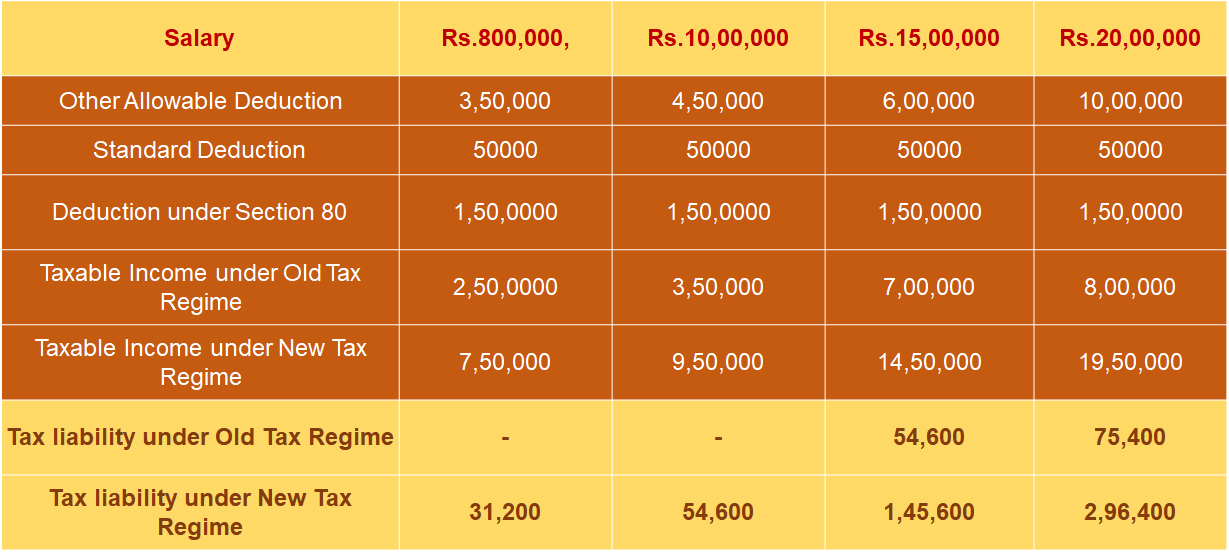
As we can see in the chart here under the new tax regime the taxable income will always be higher than the old tax regime in the same salary brackets. The reason for this is that the old tax regime offers more deductions after standard deduction.


