


ITAT Upholds Allowability of Prior-Period Expenses and Capital Subsidies; Favours Assessee
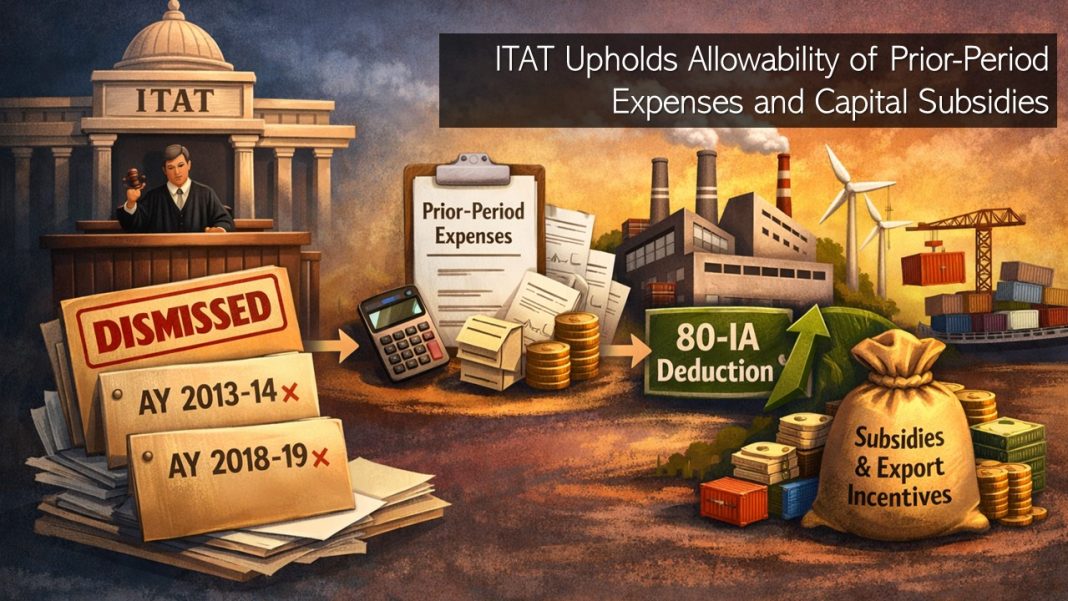
ITAT Delhi dismissed Revenue appeals for AYs 2013-14 and 2018-19, upholding CIT(A). Prior-period discounts were allowed when finalised. Section 80-IA deduction restored. Subsidies and MEIS incentives were rightly treated as capital receipts. Assessee’s cross-objection became infructuous before the tribunal finally.
The two appeals have been filed by DCIT and the cross objection by a company, namely Crystal Crop Protection Limited, in the ITAT Delhi. Both the appeals are related to the said aforesaid company. The matters relate to Assessment Years (AY) 2013-14 and 2018-19. Since all cases involved the same assessee, the Tribunal heard them together and passed a common order.
For Assessment Year 2013-14:
The key dispute was whether “prior period expenses” of around Rs. 2.37 crore, claimed as customer discounts, were allowable. The company claimed that despite the discount policy started previously, the exact amount of discount was finalised only during the year in consideration; hence, it should be allowed to be claimed. However, the Assessing Officer (AO) did not accept the assessee’s claim and made an addition to the income of the assessee.
When the case was taken before the CIT(A), the CIT(A) endorsed the claims of the assessee company and deleted the addition made by the AO. The aggrieved tax department thereafter filed an appeal before the ITAT Delhi, challenging the decision of the CIT(A). When the tribunal analysed the facts of the case, it found the ruling given by the CIT(A) as valid and dismissed the Revenue’s appeal for AY 2013-14 on the grounds that expenses can be allowed in the year in which they are finally determined, even if they relate to earlier years.
For Assessment Year 2018-19:
ITAT Upholds Allowability of Prior-Period Expenses and Capital Subsidies; Favours Assessee
This appeal was filed by the Tax Department late by 20 days; however, the tribunal condoned the delay, finding the reason explained by the Tax Department as genuine. The key dispute this year was related to deduction under section 80-IA for power generation units.
The assessee had declared its total income at Rs. 1,67,09,03,400 for the year in consideration. During the assessment of the return, the Assessing Officer reduced the deduction by allocating indirect expenses to these units. However, the company stated that no such indirect expenses were incurred and that separate audited books were maintained for the power units.
The aggrieved assessee filed an appeal before the CIT(A). The CIT(A), when analysing the case, accepted the claims of the assessee and deleted the addition made by the AO on the ground that expenses cannot be allocated on guesswork when the books are audited, and no defects are found.
There was also another key issue related to this AY 2018-19, related to subsidies and incentives. The company claimed excise duty subsidy, GST subsidy, and MEIS export incentives as capital receipts by raising additional grounds before the CIT(A). The tax department challenged these claims before the ITAT Delhi, arguing that they were not given the opportunity to cross-check or examine these claims.
However, by citing earlier judgements of the Delhi High Court, including one relating to the company’s own earlier case, the tribunal rejected this objection of the tax authorities, holding that the CIT(A) had equal rights as an assessing officer in this context and was allowed to accept additional grounds if required and decide on them.
Accordingly, the tribunal agreed with the assessee’s claim to treat excise duty and GST subsidies received under the Jammu & Kashmir industrial policy as capital receipts, as they were meant to promote industrial development and employment. In a similar way, the MEIS incentive was allowed to be treated as a capital receipt since it was meant to encourage manufacturing and exports. Since the tax department could not serve any documentary evidence opposing the same, the tribunal upheld all the findings of the CIT(A).
In conclusion, both appeals filed by the Revenue for AY 2013-14 and AY 2018-19 were dismissed. Since the revenue’s appeals failed, the cross-objection filed by the assessee became unnecessary and was also dismissed.
Citation: DCIT Vs Crystal Crop Protection Limited (ITAT Delhi); ITA No.2379/Del/2023 and ITA No.2330/Del/2023; 2013-14 and 2018-19; 09/01/2026


